Neal A. Doran and Matthew McLain
Cambridge Scholars Publishing · 2026 · 247 pages
Paperback ISBN 978-1-0364-8102-5
Ebook ISBN 978-1-0364-8103-2

Libraries: order through GOBI or your usual supplier (ISBN 978-1-0364-8102-5)

About the book

How are dinosaurs actually distributed in the space of possible forms? Using multivariate statistics across sixteen dinosaur groups, this book maps dinosaur morphospace and finds clear clusters and discontinuities that persist across analytical methods. Part I explains the methods in readable terms and applies them group by group. Part II asks what these patterns mean for classification, causation, and how scientists come to know, drawing on Michael Polanyi, Stanley Jaki, and Étienne Gilson to argue for emergence over strict reductionism.

Why this matters

Modern classification arranges organisms as branches on a continuous tree. Yet when dinosaurs are plotted by their actual anatomy, they form distinct clusters separated by real gaps, and the pattern holds across different statistical methods. This book takes that pattern seriously, both as data and as a question about what biological groups are and how we know them.

Featured results
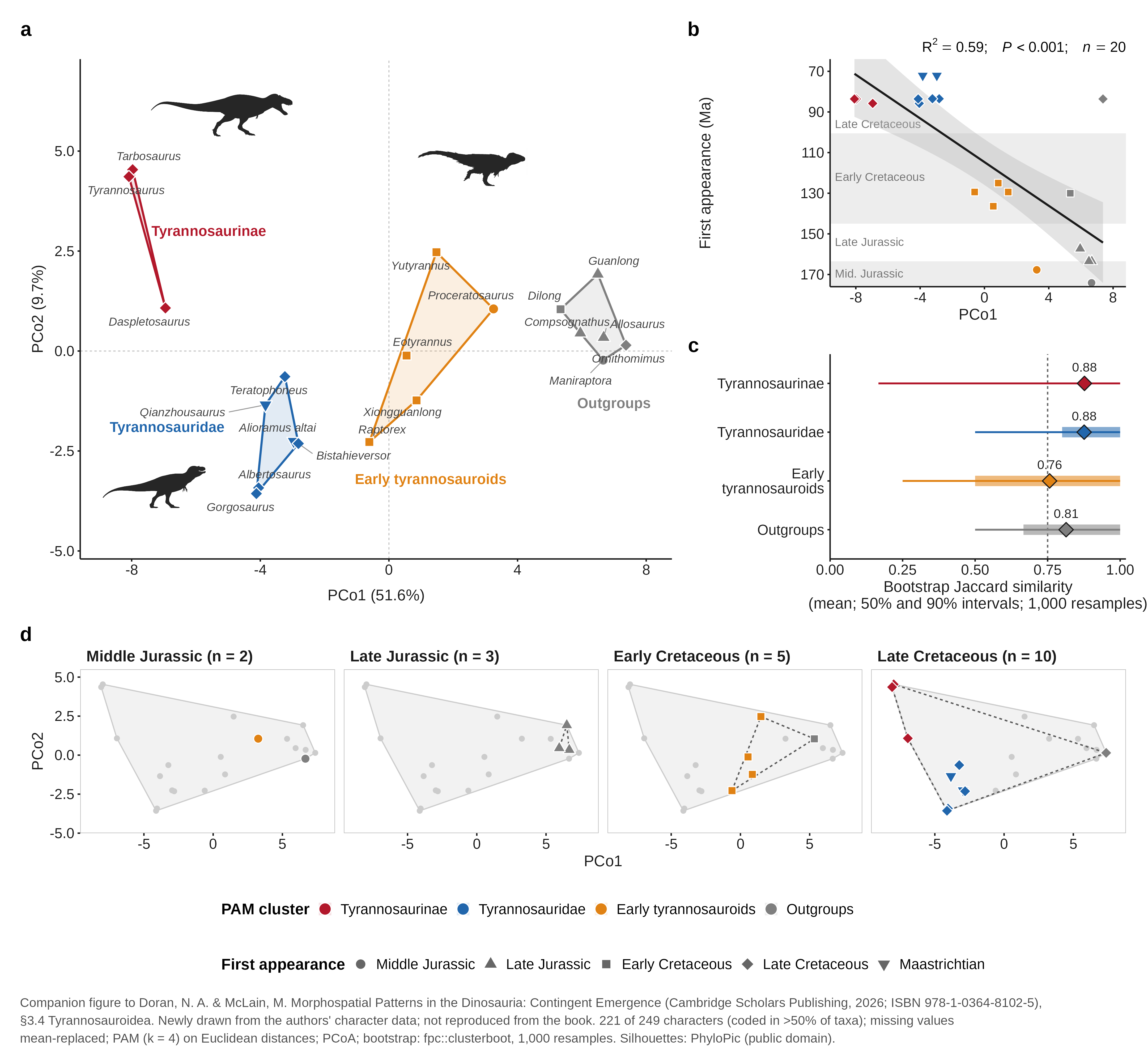
Four-panel scientific figure on tyrannosauroid dinosaur morphospace. Panel a: scatter plot of 20 taxa forming four colored clusters (red Tyrannosaurinae with Tyrannosaurus and Tarbosaurus; blue Tyrannosauridae with Albertosaurus and Gorgosaurus; orange early tyrannosauroids with Yutyrannus and Eotyrannus; gray outgroups with Allosaurus), with dinosaur silhouettes. Panel b: first-appearance age against the first axis, a downward trend from Jurassic to Late Cretaceous. Panel c: bootstrap stability of the four clusters, means 0.76 to 0.88. Panel d: four small maps showing which parts of morphospace were occupied in the Middle Jurassic, Late Jurassic, Early Cretaceous and Late Cretaceous.
Tyrannoasauroidea morphospace. a, Principal coordinates (PCo) of 221 anatomical characters for 20 taxa. Partitioning around medoids (PAM, k = 4) recovers four clusters: Tyrannosaurinae, Tyrannosauridae, early tyrannosauroids and outgroups; symbols mark the interval of first appearance. b, First appearance against PCo1 (R² = 0.59, P < 0.001, n = 20; line, least-squares fit with 95% confidence band). c, Cluster stability under 1,000 bootstrap resamples (diamonds, mean Jaccard similarity; bars, 50% and 90% intervals; dashed line, 0.75 stability threshold). d, Morphospace occupied by taxa first appearing in each interval (grey, total occupied space). Companion figure to Doran & McLain, Morphospatial Patterns in the Dinosauria: Contingent Emergence (Cambridge Scholars Publishing, 2026), §3.4.
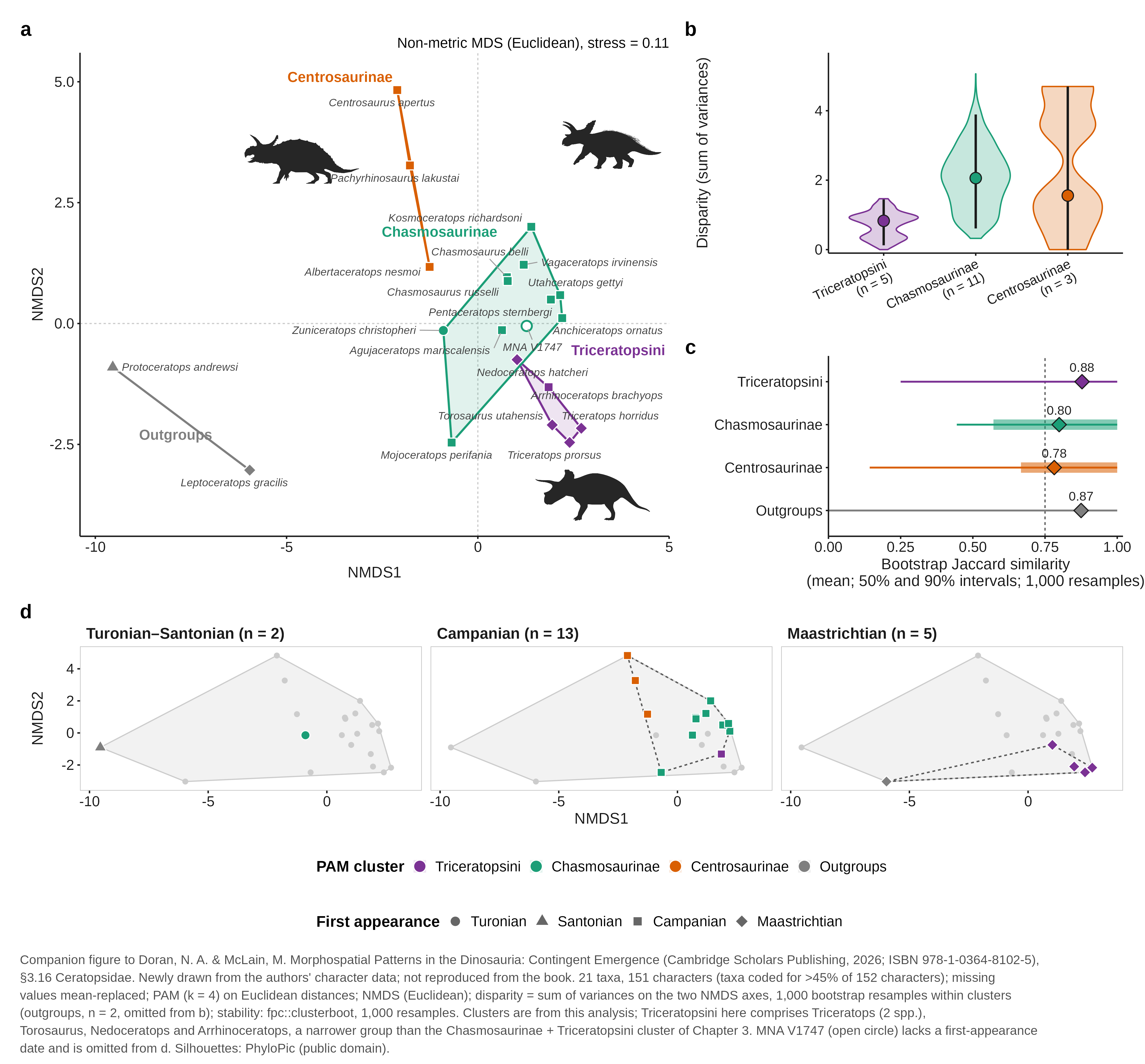
Four-panel scientific figure on ceratopsid dinosaurs. Panel a: scatter plot of 21 horned dinosaurs forming colored clusters (purple Triceratopsini including Triceratops and Torosaurus; green Chasmosaurinae including Chasmosaurus and Kosmoceratops; orange Centrosaurinae including Centrosaurus and Pachyrhinosaurus; gray outgroups Protoceratops and Leptoceratops) with horned-dinosaur silhouettes. Panel b: violin plots of morphological disparity for the three ceratopsid clusters. Panel c: bootstrap stability of the four clusters, means 0.78 to 0.88. Panel d: three small maps showing morphospace occupied in the Turonian–Santonian, Campanian and Maastrichtian.
Ceratopsidae morphospace. a, Non-metric multidimensional scaling (Euclidean; stress = 0.11) of 151 anatomical characters for 21 ceratopsian taxa. Partitioning around medoids (PAM, k = 4) recovers Triceratopsini, Chasmosaurinae, Centrosaurinae and outgroups (Protoceratops, Leptoceratops); symbols mark the stage of first appearance. b, Disparity (sum of variances on the two NMDS axes) within each ceratopsid cluster, from 1,000 bootstrap resamples (points, medians; bars, 95% intervals). c, Cluster stability under 1,000 bootstrap resamples (diamonds, mean Jaccard similarity; bars, 50% and 90% intervals; dashed line, 0.75 stability threshold). d, Morphospace occupied by taxa first appearing in each interval (grey, total occupied space). Companion figure to Doran & McLain, Morphospatial Patterns in the Dinosauria: Contingent Emergence (Cambridge Scholars Publishing, 2026; ISBN 978-1-0364-8102-5), §3.16. Newly drawn from the authors’ character data; not reproduced from the book. Clusters are from this analysis; Triceratopsini here comprises Triceratops (2 spp.), Torosaurus, Nedoceratops and Arrhinoceratops, a narrower group than the Chasmosaurinae + Triceratopsini cluster of Chapter 3.
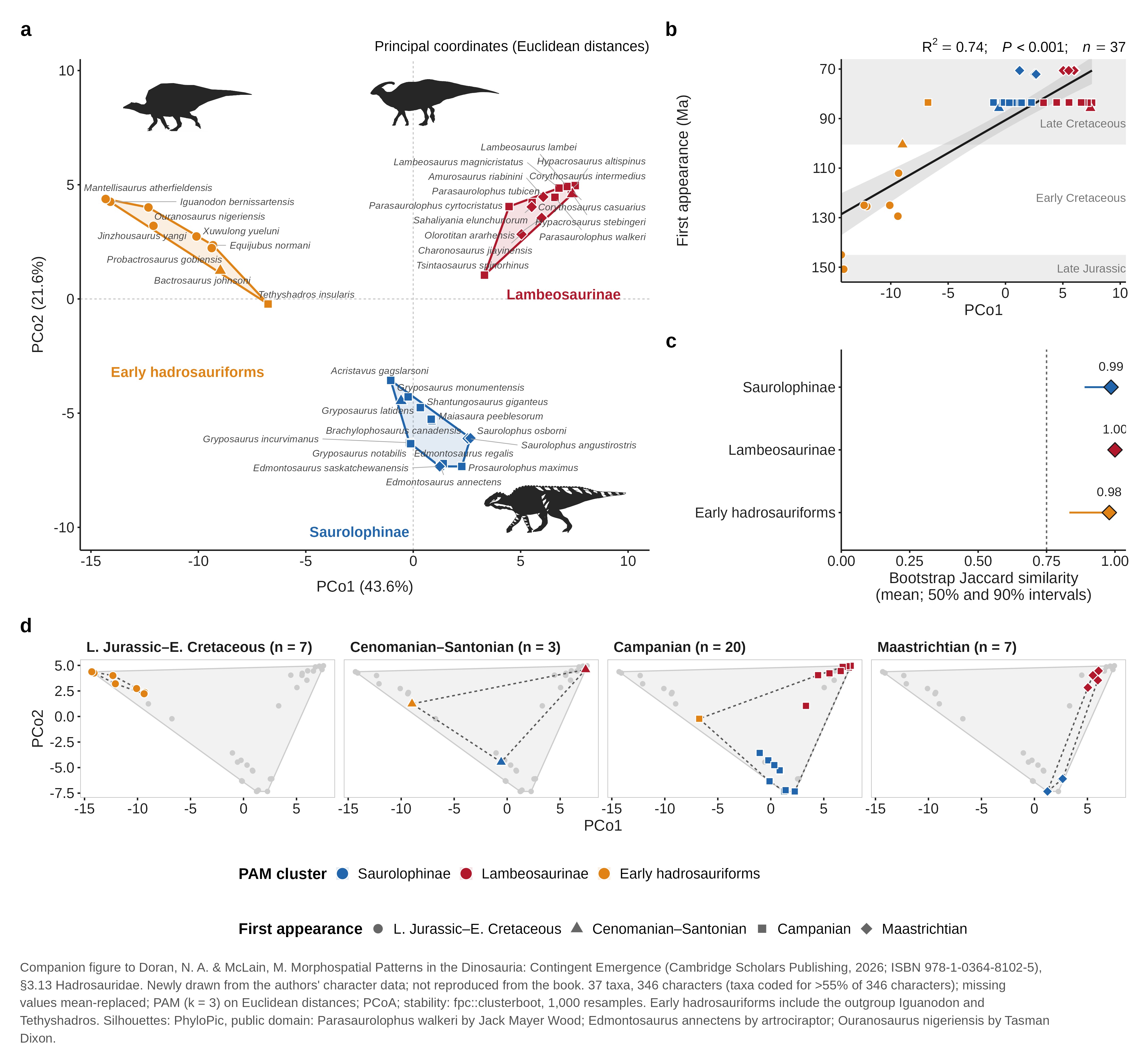
Four-panel scientific figure on duck-billed dinosaurs. Panel a: scatter plot of 37 hadrosaurs and relatives in three well-separated colored clusters (blue Saurolophinae including Edmontosaurus, Maiasaura and Gryposaurus; red Lambeosaurinae including Parasaurolophus, Corythosaurus and Lambeosaurus; orange early hadrosauriforms including Iguanodon and Ouranosaurus), with silhouettes. Panel b: first-appearance age against the first axis, a strong trend from Early to Late Cretaceous. Panel c: bootstrap stability of the three clusters, 0.98 to 1.00. Panel d: four small maps of morphospace occupied through time.
Hadrosaur morphospace. a, Principal coordinates (Euclidean distances) of 346 anatomical characters for 37 hadrosauriform taxa. Partitioning around medoids (PAM, k = 3) recovers Saurolophinae, Lambeosaurinae and early hadrosauriforms (including the outgroup Iguanodon and Tethyshadros); symbols mark the interval of first appearance. b, First appearance against PCo1 (R² = 0.74, P < 0.001, n = 37; line, least-squares fit with 95% confidence band). c, Cluster stability under 1,000 bootstrap resamples (diamonds, mean Jaccard similarity; bars, 50% and 90% intervals; dashed line, 0.75 stability threshold). d, Morphospace occupied by taxa first appearing in each interval (grey, total occupied space). Companion figure to Doran & McLain, Morphospatial Patterns in the Dinosauria: Contingent Emergence (Cambridge Scholars Publishing, 2026; ISBN 978-1-0364-8102-5), §3.13. Newly drawn from the authors’ character data; not reproduced from the book.
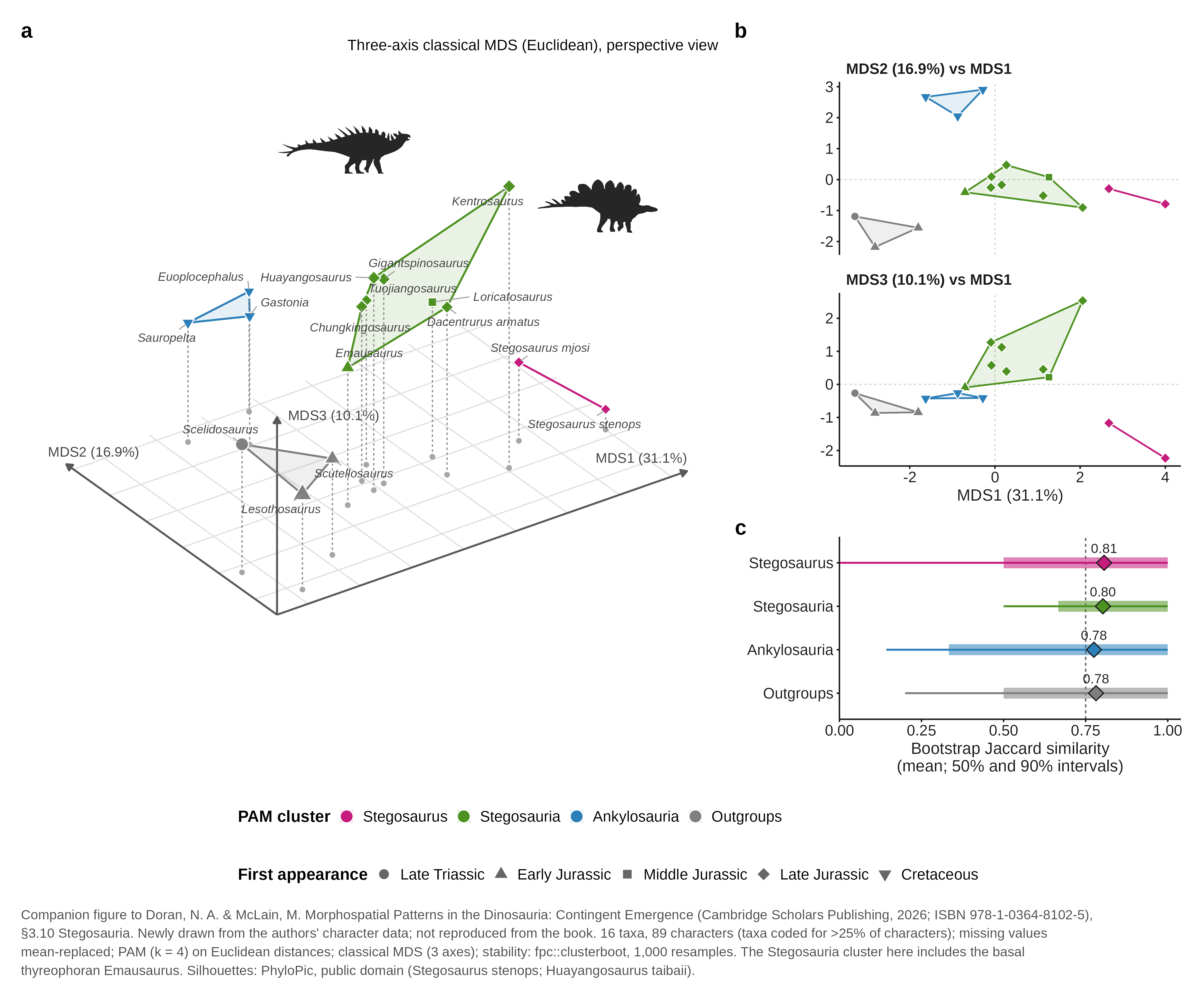
Three-panel scientific figure on stegosaurs and their relatives. Panel a: a three-dimensional scatter plot in perspective showing 16 armored dinosaurs in four colored clusters (magenta Stegosaurus; green other stegosaurs such as Kentrosaurus and Huayangosaurus; blue ankylosaurs Euoplocephalus, Gastonia and Sauropelta; gray early thyreophorans such as Scelidosaurus), with stegosaur silhouettes. Panel b: two flat views of the same space. Panel c: bootstrap stability of the four clusters, means 0.78 to 0.81.
Stegosaur morphospace. a, Three-axis classical multidimensional scaling (Euclidean distances) of 89 anatomical characters for 16 thyreophoran taxa, shown in perspective; dashed lines drop each taxon to the MDS1–MDS2 plane. Partitioning around medoids (PAM, k = 4) recovers Stegosaurus, other stegosaurs, Ankylosauria and outgroups; symbols mark the interval of first appearance. b, The same space projected onto MDS1–MDS2 and MDS1–MDS3. c, Cluster stability under 1,000 bootstrap resamples (diamonds, mean Jaccard similarity; bars, 50% and 90% intervals; dashed line, 0.75 stability threshold). The Stegosauria cluster includes the basal thyreophoran Emausaurus. Companion figure to Doran & McLain, Morphospatial Patterns in the Dinosauria: Contingent Emergence (Cambridge Scholars Publishing, 2026; ISBN 978-1-0364-8102-5), §3.10. Newly drawn from the authors’ character data; not reproduced from the book.

Figures, scripts and captions: [https://doi.org/10.5281/zenodo.24636627]

Contents

Foreword by Kurt P. Wise
Chapter 1. Introduction
Part I: Methodology and Morphospatial Analysis
Chapter 2. Methods and Data
Chapter 3. Resulting Patterns in the Dinosauria (sixteen groups, from “basal” Saurischia to Ceratopsidae)
Part II: Philosophical Implications
Chapter 4. The Meaning of Morphospace: Causation in Dinosaur Classification

About the authors
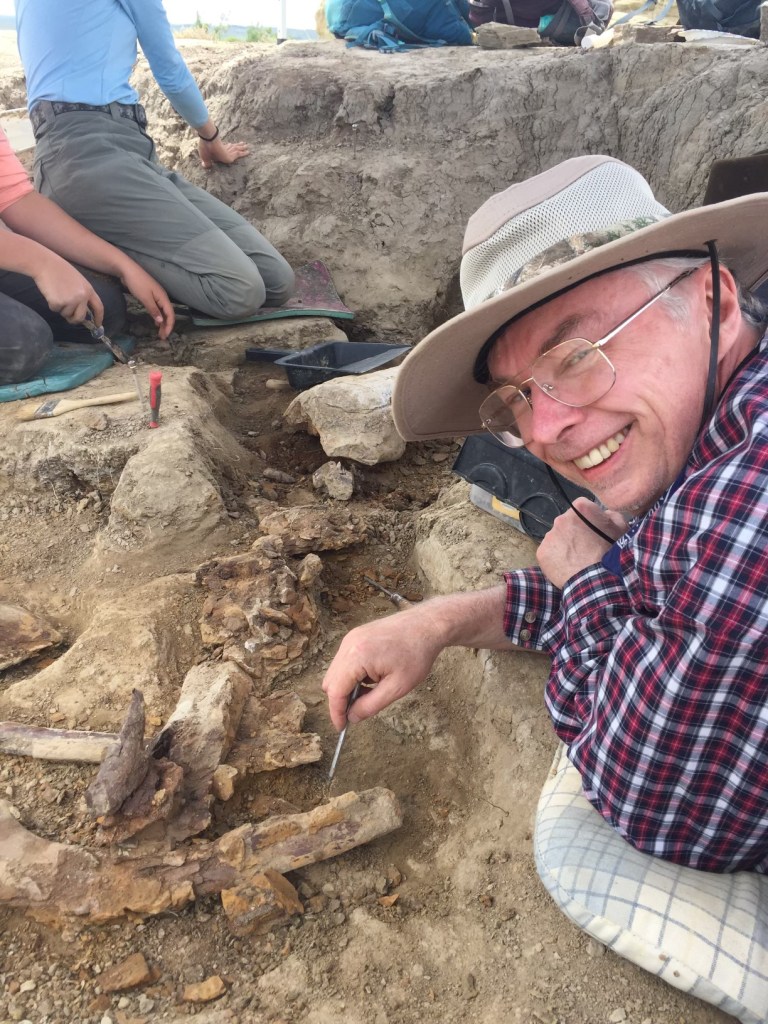
Neal A. Doran, PhD, is a paleobiologist, Professor of Biology at Bryan College, and co-author of Morphospatial Patterns in the Dinosauria (Cambridge Scholars Publishing, 2026). He builds large scientific databases and applied AI tools to study the history of life, and writes about what its patterns tell us about nature and how we come to know it.

Google Scholar · ORCID · ResearchGate

Matthew McLain is the Dean of the School of Science, Math, Technology, and Health, and an Associate Professor of Biology and Geology at The Master’s University in Santa Clarita, California, USA. He holds a PhD in Earth Sciences from Loma Linda University, USA. Dr McLain is a vertebrate paleontologist, focusing on dinosaurs, pterosaurs, and therapsids.

Frequently asked questions

What is a morphospace?
A map of anatomical form. Each organism is placed by its coded anatomical features, so similar forms plot close together and dissimilar forms plot far apart.

What methods does the book use?
Ordination methods applied to anatomical character data: multiple correspondence analysis (MCA), principal coordinates analysis (PCoA), and non-metric multidimensional scaling (NMDS), using several distance measures. Chapters 1 and 2 explain them for non-specialists.

What does the book find?
In Morphospatial Patterns in the Dinosauria: Contingent Emergence (Cambridge Scholars Publishing, 2026), Neal A. Doran and Matthew McLain analyze sixteen dinosaur character matrices—using MCA, PCoA, NMDS, PCA, and PAM medoid clustering—and find that taxa form distinct, persistent clusters separated by empty morphospace across methods.

Who is the book for?
Paleontologists, dinosaur enthusiasts, and philosophers and historians of science interested in classification, emergence, and how we know.

What is baraminology?
An approach to classification, introduced by Kurt P. Wise, that looks for both continuity and discontinuity among organisms. The book’s Foreword traces its history.

How does the book connect dinosaurs to the philosophy of biology?
Chapter 4 uses dinosaur morphospace clusters to challenge nominalism and strict reductionism, drawing on an expansion of Stephen Jay Gould’s aptive triangle, Michael Polanyi’s dual control and tacit knowledge, and Étienne Gilson’s moderate realism to argue that biological forms are contingent entities reflecting real natural kinds, formal constraints, and teleology.

How to cite

Doran, N. A., & McLain, M. (2026). Morphospatial patterns in the Dinosauria: Contingent emergence. Cambridge Scholars Publishing.

Talks and media

Coming soon.