
Saturday was the beginning of Cedarville’s Reclaiming Wisdom conference. The conference was a success; I would like to see a similar conference at Bryan sometime. A personal highlight of the third day was catching up with an old friend, Mike Bowling of Cincinnati. Sometime after I left Cincinnati Mike began a several year ordeal with cancer. His book details an amazing story. He had cancer in four places and his doctors are at a loss to describe his healing. You can read his story here; the word miracle is hard to avoid.

The first speaker was philosopher John Gilhooly. His talk involved creation as a “control belief.” Control beliefs define lower beliefs (such as specifics of science). This would look like P –> Sci (where Philosophy is “upstream” of Science). His thesis was clear and persuasive. That is, that scientists hold many ideas that frame—and contour—their specific scientific beliefs. Theology (for a Christian) is further “upstream” from philosophy and science, hence T –> P –> Sci. Thus, for a Christian it is only natural that theology will form a critical role in scientific interpretation.
The logic is hard to escape. So that if God exists, then it is necessarily true there are large implications for reality. Just as for an atheist, one would expect there to be downstream consequences in interpretation of material realities so too would there be for a theist. Interestingly, we are in an age when God’s existence is seen as increasingly warranted by academic philosophers. Thus the downstream consequences for scientific belief are likewise warranted.
The next talks were part of a parallel session. Paul Garner spoke on the state of the creation model at the same time Todd Wood gave a talk on human origins. I hated to miss Todd’s talk, but I chose Paul since I have not seen him in a while. Paul did a superb job summarizing the creation model. What I liked about Paul’s presentation, like his book, was how lucidly he connected a range of scientific issues. Anyone new to creation model thinking could easily get lost within 20 years of esoteric, technical debate. But Paul tied it together seamlessly. For biology Paul started at baraminology, and worked logically into AGEing, Wise and Croxton’s Rafting Model, and Natural Evil. The latter included a quick highlight of a pre-Fall “biological contingency” position. For example, how do we explain the architectural design of venomous snakes, such as pit vipers, in a good Creation? Gordon Wilson’s proposal is that genes may have been present in the pre-Fall world and emerged contingently at the Fall.
On the physical science side, Paul had to cover an even wider range of topics—Catastrophic Plate Tectonics (CPT), post-Flood atmospheric results, ice advance(s), stratigraphy/biome explanations, radioactive decay, and even creation cosmology. He again tied years of work into a smooth, coherent presentation.

Following this was another plenary—Kurt Wise’s talk on the Problem of Evil—followed by another parallel session. For the parallel session I chose Jeremey Blaschke’s talk on the philosophy of conservation of beauty in nature. This was a wonderful talk with a simple thesis: our role as disciples of Christ is to increase the beauty of our world through Christ-like sacrificial love. God’s ultimate aim was always a beautiful world and we have a role in restoring it. Disease, parasitism, and pollution are examples of ugly elements of nature that we must correct in order to restore proper harmony within the created order.
The third parallel session included W. Gary Phillips speaking on Creation and Hermeneutics. The first thing you note is Gary’s humor–yet all directed toward substantive content. Personally disturbing for me was realization of how sparse the word hermeneutics has been in the 20 years. Just to be clear, I realize there are biblical theological and “storied” elements of Scripture—at the same time the talk made reflect on how the “story” of Scripture has superseded discussion of hermeneutics and interpretation. (These are the reflections of a lay person but I do wonder where evangelicalism is drifting.)
I don’t want to read too deeply into the implications of this talk but it did raise a concern of relativism. One joke underscored modern subjective evangelicalism. For example, Jesus’ opponents used all the tools they had to oppose his message. One argument distinctly missing from Jesus’ fiercest opponents—an argument we hear frequently today—was “you can make David say anything you want, besides his writings are poetic—not historical.” If this mindset existed in the first century its record never merited inclusion in Scriptural texts.
The last talk was a plenary by Peter J. Gentry, Old Testament professor of Southern Baptist Theological seminary. Genesis 1 and 2 are sometimes referred to as two accounts of creation. For some, this suggests different authorship based on the premise of a textual contradiction. Rather, Gentry’s talk suggested that Genesis 1 and 2, rather than contradicting, reflect a normal pattern of Hebrew literature.
Two key words highlighted here were image and likeness. These words set the stage for understanding humanity as part of a covenant relationship with God and provide us a proper self-understanding—a critical goal of the texts.
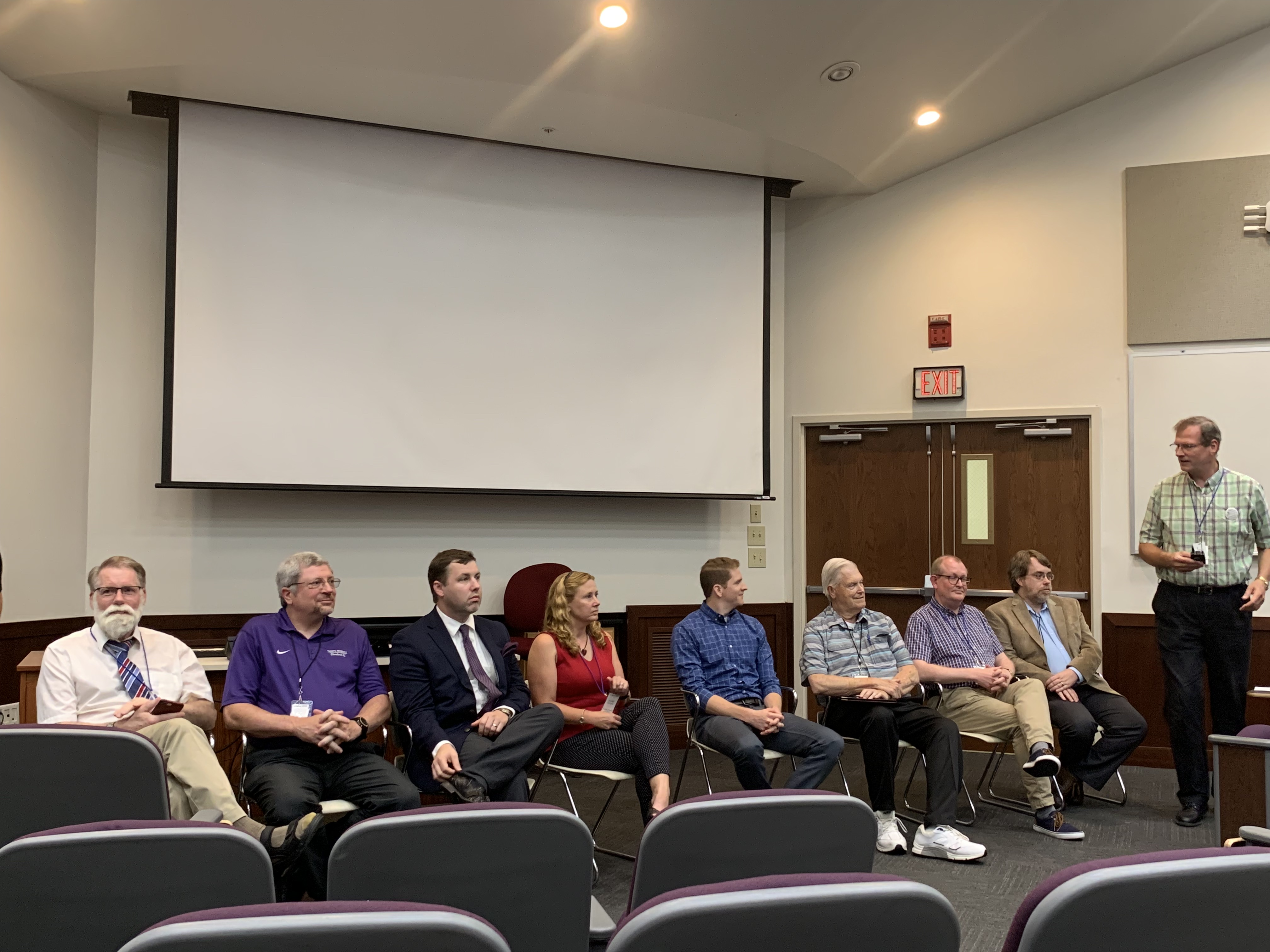
 Faith and Reason-25